Showing posts with label brain tumours. Show all posts
Showing posts with label brain tumours. Show all posts
Monday, 6 June 2022
5 Types of Paediatric Cancer You Need to Know About
Here is another one I wrote a few years ago on the Max Healthcare platform. This talks about the 5 Types of Paediatric Cancer You Need to Know About


Wednesday, 16 September 2020
Milestones in Childhood Cancer Collaborative Research - Part 1
September is Childhood Cancer Awareness Month and it is a good time to reflect on the progress we have made in curing childhood cancer and how we got here. An important part has been the ability of all stakeholders to get together and enroll children with cancer on to clinical trails, specially multicentre collaborative research. In this first part I look at some of the earliest works done in North America and Europe and highlight a few studies.

This all started in 1948 when Sidney Farber attempted to use a folate antagonist, Aminopterin to block the function of folic acid in patients with acute leukemia in hopes of achieving remission - Temporary remissions in acute leukemia in children produced by folic acid antagonist, 4-aminopteroyl-glutamic acid. Of 16 children, 10 demonstrated clinical, hematological and pathological evidence of improvement for three months. At that time this observation was met with disbelief and also it was felt to be unethical to "experiment" with the life of a child with leukemia when cure was not possible.
Thankfully, he and others like him continued in their efforts. The relative rarity of the disease and the need for shared expertise in management led to the creation of the first pediatric oncology co-perative groups (Cancer and Leukemia Group B Cooperative Group as well as the Acute leukemia Chemotherapy Cooperative Study Group A) in the US in 1955 which were the forerunners of the now well established and respected Children's Oncology Group. For the last 65 years, COG in North America and SIOP in Europe have increased our knowledge and understanding of childhood cancers and conducted studies which have improved outcomes. Here are some of the earliest studies:
Childhood Leukemia
Published by Heyn et al in 1960, The Comparison of 6-Mercaptopurine with the Combination of 6-Mercaptopurine and Azaserine in the Treatment of Acute Leukemia in Children: Results of a Cooperative Study was the first multi-centre co-operative clinical trial in childhood cancer. In 125 cases of previously untreated acute leukemia in children, no significant difference was seen in the percentage of complete remissions obtained when 6-mercaptopurine was used alone or when 6-mercaptopurine and azaserine were used in combination. The median duration of the complete remissions for the combination therapy was 4.12 months compared to 2.75 months for 6-mercaptopurine alone and the difference was not statistically significant.
At the same time, Freireich et al studied 6-Azauracil in patients with "advanced" acute leukemia, refractory to standard chemotherapy - Evaluation of a New Chemotherapeutic Agent in Patients with "Advanced Refractory" Acute Leukemia. Studies of 6-Azauracil. Under the conditions of the study this compound was found to have no significant antileukemic activity.
Two decades later, in 1980, the first collaborative efforts in childhood ALL from Europe were published on children treated on the BFM 70/76 protocol - The Berlin Childhood Acute Lymphoblastic Leukemia Therapy Study, 1970–1976. The treatment protocol consisted of vincristine, prednisone, daunorubicin, L-asparaginase, cyclophosphamide, cytarabin, 6-mercaptopurine, intrathecal methotrexate, and cranial or craniospinal irradiation. Maintenance therapy was cyclic sequential administration of intravenous methotrexate and oral 6-mercaptopurine with 6-week reinduction pulses of prednisone/vincristine. 56.2% of patients were in complete continuous remission for a median of 67 months.
Childhood Solid Tumours
Following the work on childhood leukemia, cooperative groups simultaneously also started looking at solid cancers. Earliest work was done on Wilms tumour on both sides of the Atlantic.
Published in 1968, maintenance dactinomycin following surgery was found to be superior (continued remission rate of 86%) compared to when no maintenance was given (continued remission rate of 48%) - Single versus multiple dose dactinomycin therapy of Wilms's tumor. A controlled co-operative study conducted by the Children's Cancer Study Group A (formerly Acute Leukemia Co-operative Chemotherapy Group A)
Colleagues in Europe investigated the role of radiotherapy and actinomycin d (dactinomycin) in Wilms tumour - Preoperative versus postoperative radiotherapy, single versus multiple courses of actinomycin d, in the treatment of Wilms' tumor. Preliminary results of a controlled clinical trial conducted by the international society of paediatric oncology (S.I.O.P.). This was the first SIOP study and also the first international randomized trial in Europe. Pre-op radiotherapy reduced the tumour rupture rate at surgery. Also there was no added benefit of post-op radiotherapy after receiving pre-op radiotherapy.
Published in 1968, maintenance dactinomycin following surgery was found to be superior (continued remission rate of 86%) compared to when no maintenance was given (continued remission rate of 48%) - Single versus multiple dose dactinomycin therapy of Wilms's tumor. A controlled co-operative study conducted by the Children's Cancer Study Group A (formerly Acute Leukemia Co-operative Chemotherapy Group A)
Colleagues in Europe investigated the role of radiotherapy and actinomycin d (dactinomycin) in Wilms tumour - Preoperative versus postoperative radiotherapy, single versus multiple courses of actinomycin d, in the treatment of Wilms' tumor. Preliminary results of a controlled clinical trial conducted by the international society of paediatric oncology (S.I.O.P.). This was the first SIOP study and also the first international randomized trial in Europe. Pre-op radiotherapy reduced the tumour rupture rate at surgery. Also there was no added benefit of post-op radiotherapy after receiving pre-op radiotherapy.
Childhood CNS Tumours
It was in 1990, that the first multicentre co-operative group studies were published on childhood CNS tumours in North America and Europe, almost at the same time. Both looked at the role of adjuvant chemotherapy in medulloblastoma.
Evans et al from the Children's Cancer study Group (another forerunner of COG) studied the benefit of adjuvant vincristine, CCNU and prednisolone after surgery and radiation in children with medulloblastoma - The treatment of medulloblastoma - Results of a prospective randomized trial of radiation therapy with and without CCNU, vincristine, and prednisone. It is concluded that chemotherapy does not benefit patients with low-stage medulloblastoma, but may benefit those with more advanced stages of disease.
Tait et al from SIOP examined adjuvant vincristine and CCNU in medulloblastoma - Adjuvant chemotherapy for medulloblastoma: The first multi-centre control trial of the International Society of Paediatric Oncology (SIOP I). Their results were that although there was no overall statistical difference between the two arms of the trial, a benefit for chemotherapy was seen in a number of sub-groups; partial or sub-total surgery, brainstem involvement , and stage T3 and T4 disease.
Tait et al from SIOP examined adjuvant vincristine and CCNU in medulloblastoma - Adjuvant chemotherapy for medulloblastoma: The first multi-centre control trial of the International Society of Paediatric Oncology (SIOP I). Their results were that although there was no overall statistical difference between the two arms of the trial, a benefit for chemotherapy was seen in a number of sub-groups; partial or sub-total surgery, brainstem involvement , and stage T3 and T4 disease.
Childhood Cancer Survivors
By the end of the 20th century collaborative research in childhood cancer survivors was in flow and the first publication from the Childhood Cancer Survivor Study came out. Marriage in the survivors of childhood cancer: A preliminary description from the childhood cancer survivor study showed a decreased likelihood of marriage among childhood cancer survivors, which may be influenced by gender and/or race
These studies are only a tiny reflection of the huge amount of collaborative work and scientific output which took place in the second half of the 20th century. Noticeably, there was a complete absence of such work from low and middle income countries (LMIC). Health professionals in these settings were also working hard to provide the best possible care to their patients while being hampered by limited resources. They were however unable to translate their efforts into regional or national collaborative efforts. Progress in this area happened much later and in my next blog post I will showcase milestones of childhood cancer collaborative research in LMIC.
Friday, 8 April 2011
Multi-Centre Study on Pediatric Brain Tumours in India
 In India, CNS tumours are the third most common childhood cancer behind leukemias and lymphomas. However, CNS tumours are a heterogeneous collection of many pathologies and till recently there has been limited data from India describing their epidemiology. For this reason the recent paper in Neurology India made welcome reading (Jain et al, 2011). In terms of results, the paper does not offer anything spectacularly new. The most common primary pediatric brain tumors were astrocytic tumors (34.7%), followed by medulloblastoma and supratentorial primitive neuro-ectodermal tumors (22.4%), craniopharyngiomas (10.2%) and ependymal tumors (9.8%). The most common astrocytic tumor was pilocytic astrocytoma.
The two main caveats to interpreting this information are - that it is not population-based data and the information is collated from pathology reports. Upto 20% of childhood CNS tumours may be diagnosed on the basis of radiology only and this group of tumours would be missing.
Despite all this, what has been most fascinating for me is the fact that this paper is a joint effort of seven institutions with nearly 4000 childhood CNS tumour patients. Such multi-institutional studies are not frequent in the paediatric haematology-oncology literature from India and the effort of the authors needs to be acknowledged.
Saturday, 1 May 2010
Brain Tumour Foundation of India
Brain tumours, the second most common group of childhood tumours, pose special challenges in diagnosis, management and long-term follow-up. A close co-operation between neurosurgeons, radiation oncologists, paediatric oncologists, neuroradiologists and neuropathologists is needed for optimal management of these children
 The Brain Tumour Foundation of India is a non-profit organisation which is committed to reducing the physical, emotional and financial suffering associated with diagnosis, treatment and rehabilitation of patients with these tumours, and their families. Various health professionals and allied professionals from Tata Memorial Hospital and King Edward Memorial Hospital, along with other organisations in Mumbai who share an interest in patients with brain tumours came together and set up this foundation nearly 10 years ago.
 The Brain Tumour Foundation of India is a non-profit organisation which is committed to reducing the physical, emotional and financial suffering associated with diagnosis, treatment and rehabilitation of patients with these tumours, and their families. Various health professionals and allied professionals from Tata Memorial Hospital and King Edward Memorial Hospital, along with other organisations in Mumbai who share an interest in patients with brain tumours came together and set up this foundation nearly 10 years ago.
Although based primarily in Mumbai, the foundation is keen to reach out to patients with brain tumour across the country. Its three main objectives are
- Quality Treatment and Care: Support for chemotherapy drugs, materials/medicines needed during surgery and radiotherapy.
- Social and Psychological Support: Activities included monthly support group meetings, celebrating festivals, organising art events, producing greeting cards (see figures) educational support, advocacy and other similar activities.
- Research
.

Thursday, 29 April 2010
Dismal Outcome of Diffuse Intrinsic Pontine Glioma

Around 10-15% of all childhood tumours of the brain are in the brain-stem. A majority of these are diffuse and infiltrating lesions of the pons called Diffuse Intrinsic Pontine Glioma (DIPG). Surgical removal of these tumours is not feasible and focal radiation in combination with experimental chemo/biologic therapeutic agents is the mainstay of treatment. Current outcomes across the world are dismal overall survival less than 10 to 15%.
In a recently published report from Tata Memorial Hospital in Mumbai, clinicians describe the outcome of 20 children with DIPG who were treated with focal radiotherapy (54 Gy in 30 fractions over 6 weeks) along with oral temozolomide during and after radiotherapy (Ref - Jalali et al, Int J Radiat Oncol Biol Phys, May 2010). This was done as a phase 2 feasibility clinical trial. Although the treatment was generally fairly well tolerated, only 35% of children were alive at 12 months after diagnosis and only 6% after 18 months.
In summary, this is one of the very few case-series on DIPG from India and the dismal outcome of these children is similar to that reported from rest of the world. I am fascinated by the complete absence of treatment refusal and abandonment in these group of patients. In a cancer, where treatment is intense and the outcome generally fatal, refusal/abandonment of treatment should theoretically be a relatively common occurrence.
Tuesday, 6 April 2010
Enabling Timely Diagnosis of Brain Tumours in Children
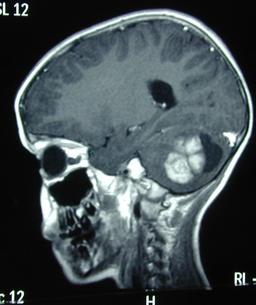
Worldwide, tumours of the brain (and other parts of the central nervous system) constitute nearly 25% of all childhood cancer (second only to acute leukaemias). Their incidence in India is lower and this is partly related to underdiagnosis as a result of inadequate neuro-radiological and neuro-surgical facilities (Ref - Arora et al, Indian Journal of Cancer, Oct-Dec 2009)
Presenting features of the brain tumour depend on the age of the child as well as the location of the tumour in the brain. However, they can be varied and include headache, nausea/vomiting, visual changes, motor changes, seizures, altered sensorium and others. The non-specificity of some of these symptoms can lead to a delay in parents seeking medical advice and in physicians reaching a diagnosis. These delays can have negative impact on outcomes.
The Children's Brain Tumour Research Centre in Nottingham University has developed evidence-based guidelines to help clinicians recognise and diagnose brain tumours in children in a timely fashion. These guideline have application across all settings and populations including in the Indian context and deserve to be widely disseminated.
Subscribe to:
Posts (Atom)