Sunday, 19 July 2020

COVID-19 Pandemic and Childhood Cancer

None of us has ever seen anything like this before. And I am not talking about a viral infection. I am talking about the emergence of a new infection and the global and national response to it which has been without parallel. Over the last few months not only has the infection affected the health of millions and taken the lives of hundreds of thousands, it has brought the world to a HALT! Individuals, businesses and countries have borne the brunt of it and continue to do so.

It will be some time before this comes to pass. Meanwhile children with cancer (like those with many other illnesses) have been caught in this maelstrom with impact on their diagnosis, their treatment and eventually outcomes. In the face of such ongoing challenges, the global and the national pediatric oncology community has got together to respond on multiple fronts in many different ways.


The Global COVID-19 Observatory and Resource Center for Childhood Cancer is one such effort. Developed by SIOP and St Jude Global, this Resource Centre provides all relevant information to those caring for children with cancer including parents and families. The reader is encouraged to browse the website for further information.

Specifically I wanted to highlight two things.

Firstly, are the weekly COVID Conversations - a live webinar to discuss difficult issues, address pressing questions, and hear the experiences of our colleagues when it comes to caring for children with cancer during this pandemic. Several such Conversations have happened with one specifically relating to Experiences in India and Pakistan.

Secondly, is the Global Registry of COVID-19 in Pediatric Cancer which provides a visualisation of the impact of the virus on our patient population.

Tuesday, 10 March 2020

Podcast on perspectives of caregivers of children with cancer in India on their journey to accessing timely cancer diagnosis and treatment


I am glad to share a podcast https://www.ghccpod.com/22-the-labyrinth/ was conducted by Dr Mark Zobeck based on one our recent pieces of work in trying to understand the experiences of the caregivers of children with cancer in India as they obtain their diagnosis and start treatment.

I quote from his link

How does a child with cancer in India access care?
If you’ve ever had an illness that was difficult to diagnose, you know that navigating the medical system can be incredibly frustrating. Bouncing back and forth between doctors, taking time off of work or school, waiting for hours upon hours, all while you don’t feel well and do not know what is going on with your body is enough to drive anyone crazy. Unfortunately for families of children with cancer, they know this feeling all too well. Childhood cancer can be very difficult to diagnose and the journeys that families undergo to find answers and receive care can be long and grueling. 
To better understand these journeys, Drs. Neha Faruqui, Ramandeep Arora, and their colleagues have studied what they call the “healthcare labyrinth” of accessing childhood cancer care in India. Through discussions with parents and caregivers, they classified the major themes that contribute to difficult or prolonged paths to care. Today on the podcast, we will discuss their findings from their many hours of listening to the families’ stories. 
I would encourage anyone listening to the podcast to also read their paper. As I say in the podcast, it reads more like a novel than a journal article, and I found myself emotionally invested in the way the parents described their journeys. It made me appreciate anew how important it is to establish robust health systems that can rapidly identify patients and refer them to appropriate tertiary care.
Lastly, this discussion is not meant to be a criticism of the Indian healthcare system. It is an enormous system that is responsible for caring for 1.3 billion people! There are many things it does very well! But of course, there are things that can be improved. As Dr. Arora says in the episode, this paper, and our discussion is about listening to the caretakers to discover how providers everywhere can better care for not only the patient during treatment but for the entire family through the entire cancer experience. 

Friday, 20 December 2019

WHO Global Initiative for Childhood Cancer

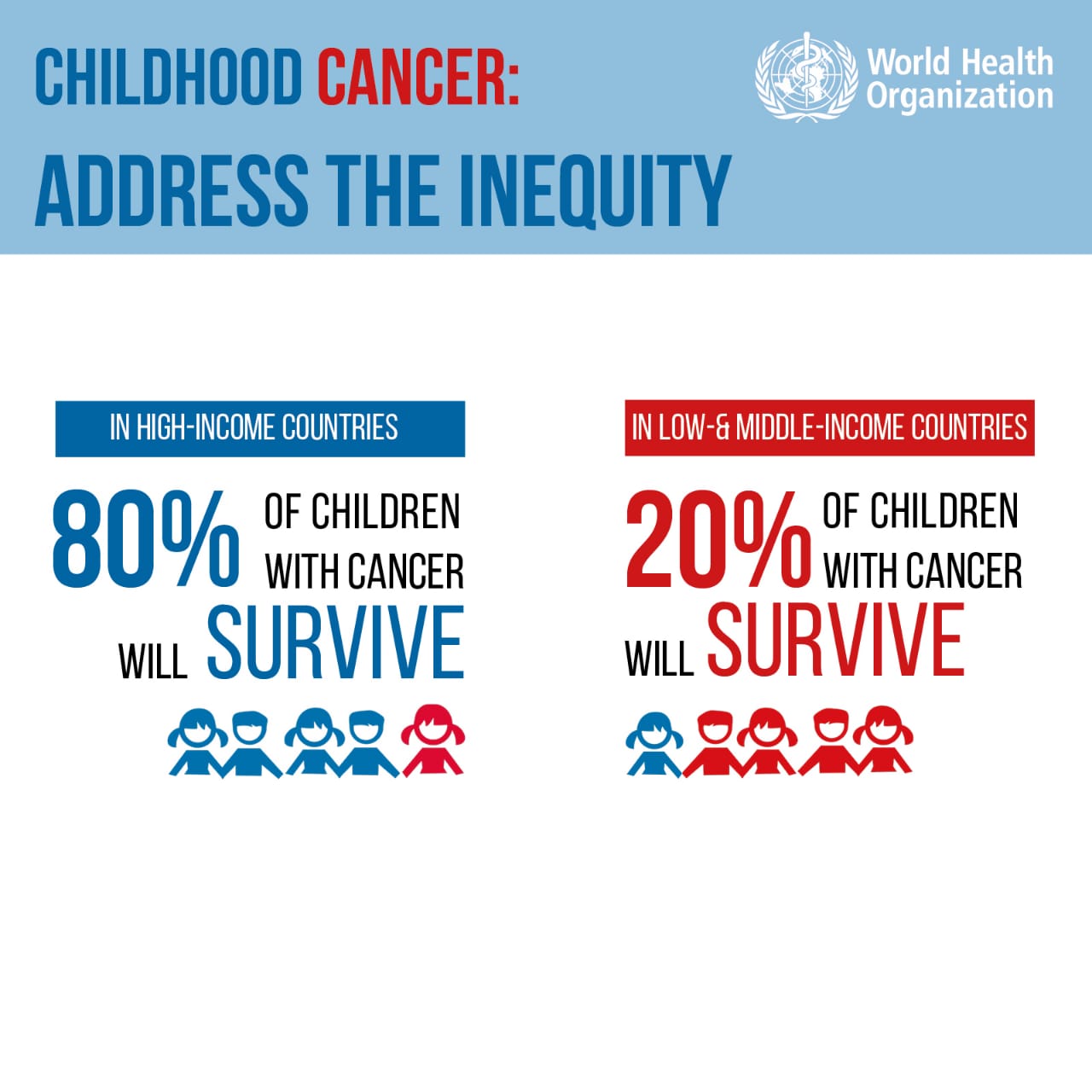
In September 2018 WHO announced a new effort – the WHO Global Initiative on Childhood Cancer – with the aim of reaching at least a 60% survival rate for children with cancer by 2030, thereby saving an additional one million lives. 

This new target represents a doubling of the global cure rate for children with cancer. The aims of the Initiative are two-fold: to increase prioritization of childhood cancer through awareness raising at global and national levels and to expand the capacity of countries to deliver best practice in childhood cancer care. Concretely, WHO will support governments to assess current capacities in cancer diagnosis and treatment including the availability of medicines and technologies; set and cost priority cancer diagnosis and treatment programs; and integrate childhood cancer into national strategies, health benefits packages and social insurance schemes.

More information can be found at the following links
https://www.who.int/cancer/childhood-cancer/en/
https://siop-online.org/who-global-initiative-for-childhood-cancer/